reading time – 5 min

How do you give them a taste for effort?

Sometimes, no matter how much we encourage our children to make an effort, repeating ourselves over and over, the message just doesn't get through. You might think some children have a natural drive while others are simply lazy. Don't panic — whether it's physical or intellectual effort, the habit of trying can be nurtured from a very young age! Here are some tips from parents on a topic that we believe is essential for growing up well.

Tip #1: Teaching them about frustration

"I think that if my children are not exposed to the unpleasant and the frustrating, their landing in the adult world could be a rough one! For me, learning to make an effort starts with a certain degree of frustration. In our house, we know how to have fun (don't worry!), but everyone has to pitch in by doing the tasks we ask of them before going off to pursue their various temptations, which vary by age (building with kaplas, collecting ladybugs, lounging on the sofa with a book…)."
Dominique, father of Mahault, Ysée, and Gonzague (8, 4, and 2 years old)

Tip #2: Valuing and praising them

"It was last week, I think — Marie (4 years old) set the table all by herself for the first time. I had been showing her how for several days and I have to admit I was impressed by her efforts. I immediately praised her out loud, so the whole family could hear! That evening, when I was putting her to bed, I brought it up again. I then remembered what her teacher had recommended at the start of the year: 'All I ask of you, as parents, is to praise your children for every effort they make at school'." Grégoire, father of Jules and Marie (7 and 4 years old)

Tip #3: Making the most of the holidays

"When I'm rushed or tired, I struggle to ask my children to tidy up the bathroom or put their shoes on by themselves before leaving for school. I tend to do it for them. I love taking advantage of the holidays, when we have more time and less stress, to develop their learning efforts. I've also noticed that generally (with a few exceptions!), the good habits formed during that time carry over into the school year."
Eléonore, mother of Arthus and Zoé (4-year-old twins)

Tip #4: Activities that instil a sense of effort

"My children have been playing music since they were 5. It takes perseverance and hard work, but in return, they are rewarded by their progress and the pieces they are now able to play. And in summer, we often go hiking in the mountains — I find that this is also a great school of effort. In these activities, there is the fact of learning to wait (for a melody to sound right or for the summit to arrive) — that is also what effort is about: the patience for results. Things don't come all at once, contrary to what our society might lead us to believe!" Arthur, father of Nicolas and Gaëtan (6 and 8 years old)

Tip #5: Adjusting your expectations to the child's age

"My three children are 2, 5, and 7 years old. Based on my experience with my eldest, I can say that my expectations haven't always been matched to his abilities! To be honest, asking him to fold a napkin at 4 years old was probably a bit ambitious. That's why I'm sharing below a (non-exhaustive!) summary of the household tasks you can reasonably ask your children to do:

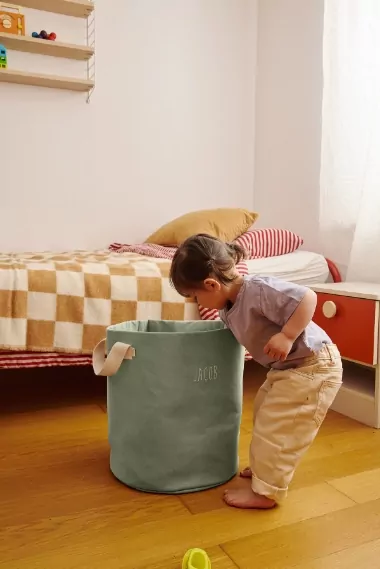
• Ages 2 to 3: putting toys away in a box, throwing rubbish in the bin, clearing away napkins, salt, and pepper, hanging their coat on a low hook. At this age, it's important to give precise instructions and to break requests down into small steps.
• Ages 4 to 5: making their bed, wiping down the kitchen table or counter, picking up their dirty dishes and putting them in the dishwasher, putting away small dishes…
• From age 6: setting the table from start to finish, emptying the dishwasher, making a pile of their clothes after undressing in the evening…"
Annick, mother of Hugo, Pétronille, and Louison (7, 5, and 2 years old)


Leading by example every day

Our lives as adults and young parents often require daily effort. It can be worthwhile (without presenting effort as a constant sacrifice!) to verbalize in front of our children that some things take effort on our part, and that we don't give up because of that (even if sometimes we dream of a hot solo bath at 6pm on a Saturday, don't we?)

Things your little ones say

"I'm laughing my eyes out."
– Eliott, 5 years old

"Mommy, I'm going to the bafroom quick."
– Léa, 2 years old

"I love you with all my silliness!"
– Ellie, 2 years old

AUTHOR

leave a comment

SHARE THIS ARTICLE