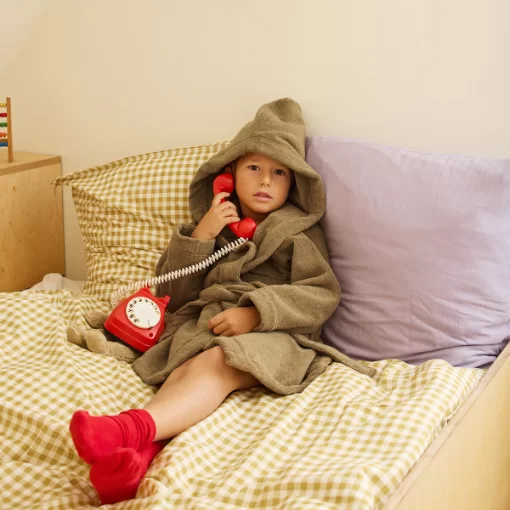
écrans et enfants

Screens are part of our daily lives… and our children's too. But how do we guide them through this learning process without feeling guilty or banning everything? How do we pass on the right habits, when we ourselves struggle to put our phones down?

In this article, we share advice from parents and experts to help teach our children to use screens wisely… and ourselves too, a little.

teaching our children about screens: it starts with leading by example!

We talk a lot about children's screen use, the effects on their development, the rules we need to set for them… But we sometimes forget that the greatest educational lever is us. Our children learn by imitation. If they see us scrolling on our phones, it's hard to ask them to disconnect. Teaching them to use screens properly starts with leading by example.

Easy to say, not always easy to do!

To help the whole family step back from screens, we're sharing a few simple tips, tested (and approved) by other parents.

screens and children: essential family rules to follow

no screens at the table, no screens in the children's bedroom

We took inspiration from the "4 No's"* rule, simple (and powerful) for children. We adapted it to our family life — us parents with our two children aged 2 and 6:

• no screens in the morning before dropping the kids off. Mornings are already hectic, so starting the day by reading a stressful email is the best way to panic and put the whole family under pressure. So we switch off, and focus on what matters: toast, cuddles, and mismatched socks.

• no screens at the table. At the table, we talk, we listen. Sometimes we laugh, sometimes we shout too, but at least we're together. Mealtime is a time for attention. Our children know our rules. Lucien even reminds us sometimes: "Dad, no screens at the table!"

• no screens in the children's bedroom. This rule really put my mind at ease. I couldn't manage to play with the kids, to truly be present with them. I remember missing a moment just because I was on my phone: my son so proud of his Kapla tower while I was checking tomorrow's weather. Since then, my phone stays out of the way.

Tristan, father of Alma (2 years old) and Lucien (6 years old)

* The 4 No's rule was designed for children by Sabine Duflo, clinical psychologist: no screens in the morning, no screens during meals, no screens before falling asleep, no screens in the child's bedroom.

turning off notifications to better manage our screen use

At first, I turned off my WhatsApp notifications, then Gmail, which were buzzing the most. I felt they were pulling me away from the present moment.

I remember a fit of laughter with the kids, interrupted by a "BEEP". A friend was canceling our Saturday plans, and in one second, the moment was ruined.

I ended up turning off all notifications and felt liberated (free at last!). My phone only rings when I get a call. Everything else can wait.

Edith, mother of Johanna (4 years old) and Emile (1 year old)

a watch to reduce the pull of the smartphone

Apparently, we check our phones over 200 times a day on average. Not easy to lead by example in those conditions.

A few months ago, I started wearing a watch again. I no longer need my phone glued to me. As a bonus, I use it to teach my daughter about time: "when the little hand is on the 8, you need to be in bed."

Anne, mother of Cassandre (4 years old)

explaining to our children why we use screens

Children understand far more than we think, as long as we explain things to them. If I use my phone in front of them, I explain what I'm doing. "No sweetheart, I'm not watching a Tchoupi video. I'm checking the weather to see if I need to pack boots in your suitcase. I'm looking up the Post Office hours to pick up the coat I bought you last week…" In short, I verbalize it. It creates less distance. In those cases, Léa accepts more easily that I'm on my screen. She understands it's not just an entertainment tool. She's gradually learning to tell the difference between screens that are useful and screens that are controlling.

Dominique, father of Léa (5 years old) and Hugo (6 months)

the expert tip: the 3-6-9-12 rule developed by Serge Tisseron

Under 3: No non-interactive screens — babies have better things to do: explore, touch, babble, cuddle!

3–6 years: Max 1 hour/day, always with an adult. And keep screens out of the bedroom and away from bedtime!

6–9 years: Clear rules, sharing, and above all… plenty of screen-free activities to grow well.

9–12 years: Internet, yes, but with mom and dad nearby to explain the pitfalls of the web.

After 12: More independence, but always within a framework (and no, no screens under the covers at night).

less screen time for more precious family moments

Less screen time isn't a punishment — it's a chance to experience the small magical moments of everyday life. Because our little ones' mischief, their angelic smiles, their first steps go by so fast. And it would be a shame to miss them because our eyes are glued to our screens, wouldn't it?

the things your little ones say

"Mommy I don't love you to infinity, that's not enough, I love you to a thousand finities!" - Nino, 5 years old

"Mommy were you born in 2000 how much?" - Alma, 6 years old

"You're pretty Mommy, can I have a candy?" - Philippine, 8 years old

leave a comment

SHARE THIS ARTICLE